Retention of accounting records in Switzerland: the 10-year rule explained
In short. In Switzerland, books and accounting records are kept for 10 years from the end of the financial year (art. 958f para. 1 CO). This applies to all businesses, self-employed people included, even with simplified accounting (art. 126 para. 3 DBG).
- 20 years for documents used to calculate VAT corrections on immovable property (art. 70 para. 3 VAT Act).
- In electronic form: accepted (art. 958f para. 3 CO), according to the requirements of the Accounting Records Ordinance (Olico).
- On paper, printed and signed: the management report and the audit report (art. 958f para. 2 CO).
Who is affected?
Every business that keeps accounts, and that is a lot of them:
- legal entities (GmbH/Sàrl, AG/SA, cooperatives…) and sole proprietorships or partnerships above CHF 500,000 turnover keep full accounts (art. 957 para. 1 CO);
- below CHF 500,000, sole proprietorships and partnerships keep a record of income, expenses and assets (art. 957 para. 2 CO). The 10-year period still applies: tax law requires the self-employed to keep their statements and supporting documents for 10 years (art. 126 para. 3 DBG);
- VAT-registered businesses keep their books, supporting documents, business papers and other relevant records until the tax claim becomes absolutely time-barred (art. 70 para. 2 VAT Act), that is 10 years after the end of the tax period (art. 42 para. 6 VAT Act).
Which documents?
| Document | Examples | Period |
|---|---|---|
| Books | General ledger, journal, accounts | 10 years |
| Auxiliary books | Payroll accounts, debtors and creditors, stock inventory | 10 years |
| Accounting records | Supplier and customer invoices, receipts, bank and postal statements, contracts underlying an entry | 10 years |
| Management report and audit report | Annual accounts, auditor’s report | 10 years, as a printed and signed copy |
| Working instructions for electronic archiving | Organisation, procedures, software used | As long as the books they describe |
| Property VAT documents | Calculation of own-use supplies, later input-tax correction on immovable property | 20 years |
An accounting record is “any written document, on paper, in electronic form or in any equivalent form, that allows the transaction to be verified” (art. 957a para. 3 CO). Every entry must have one (art. 957a para. 2 no. 2 CO). The books and auxiliary books are described in art. 1 of the Olico; the working instructions, in its art. 4.
When does the clock start?
The period runs from the end of the financial year, not from the date of the document (art. 958f para. 1 CO):
| Financial year | Closing date | Keep until |
|---|---|---|
| Calendar year 2026 | 31 December 2026 | 31 December 2036 |
| Offset year 2025-2026 | 30 June 2026 | 30 June 2036 |
The simplest approach: one folder per financial year, which you destroy in one go ten years after it closes.
And after the business closes? The obligation does not disappear with the activity. For a dissolved AG (SA), for example, the company’s books are kept in a safe place for ten years after its deregistration (art. 747 CO).
Paper or electronic?
The principle: both are accepted. Books and accounting records may be kept on paper, electronically or in an equivalent form, provided the link with the transactions is guaranteed and they remain readable under all circumstances (art. 958f para. 3 CO).
The exception: the management report and the audit report are kept as a printed and signed copy (art. 958f para. 2 CO).
The conditions for electronic archiving are set by the Olico: integrity (no change without a trace), documented procedure, availability at any time, organised and protected archives, non-modifiable media or technical safeguards (electronic signature, timestamp), documented migrations. We detail them in Digital archiving: what is a scan worth in law in Switzerland?
For VAT, electronic supporting documents follow the same rules: the VAT Ordinance refers to the Code of Obligations and the Olico (art. 122 VAT Ordinance).
The most common mistakes
- Counting from the invoice date instead of the end of the financial year: you destroy a year too early.
- Forgetting the bank statements of the business account: they are accounting records too.
- Keeping records in your mailbox: a mailbox is neither organised, nor protected against deletion, nor durable.
- Mixing private and business, which forces you to sort things out just when the fiduciary or the tax authority asks for a document.
- Destroying property documents subject to VAT too early, which fall under the 20 years.
For private documents (tax, insurance, health, housing), the periods are different: see How long to keep your bills and documents in Switzerland
Gather and find your records with Charti
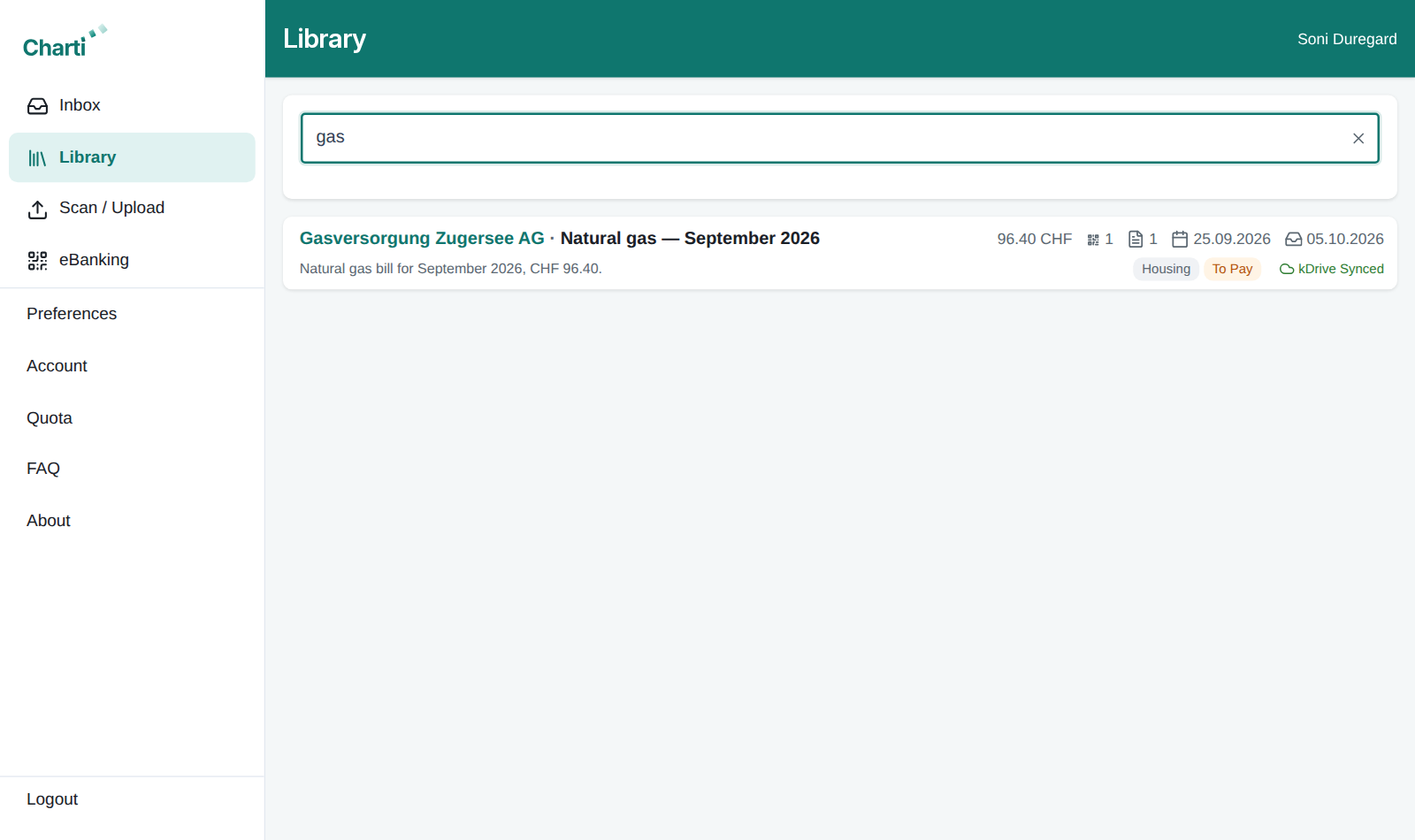
Charti helps a self-employed person lose no record and find them again: supplier invoices received by e-mail or scanned, statements, contracts. Each document is read, filed by type, issuer and date, and a copy arrives on your computer, organised the way you choose: by issuer then by year, by year first, or in your own folder structure. Search covers the content of documents.
Charti is not an archive certified as Olico-compliant: for the legal retention of your books and accounting records, follow the procedure agreed with your fiduciary or your accounting software.
Frequently asked questions
Do self-employed people have to keep their accounting records for 10 years?
Yes, even with simplified accounting. The Code of Obligations sets 10 years for books and accounting records (art. 958f CO), and the Federal Direct Tax Act requires the self-employed to keep their statements and the supporting documents for their activity for 10 years (art. 126 para. 3 DBG).
When does the 10-year period start?
At the end of the financial year (art. 958f para. 1 CO). An invoice from March 2026, in a financial year closed on 31 December 2026, is therefore kept until 31 December 2036.
Can I keep accounting records only in electronic form?
Yes, except for the management report and the audit report, which must be kept as a printed and signed copy (art. 958f para. 2 CO). Books and records may be kept electronically if the link with the transactions is guaranteed and they stay readable under all circumstances (art. 958f para. 3 CO), according to the requirements of the Olico.
Do I have to keep the business account’s bank statements?
Yes. They are supporting documents: they prove the payments and receipts recorded in the accounts. They are kept for 10 years, like invoices.
What should I do with accounting records after 10 years?
You can destroy them, by shredding them or permanently deleting the files. Keep, however, those linked to a procedure in progress, such as a tax audit or a dispute, and those used for property VAT, which are subject to 20 years.
This guide is for information only and is not legal or tax advice. If in doubt, ask your cantonal tax office or your fiduciary.