How long to keep your bills and documents in Switzerland: the full table
In short. In Switzerland, a private individual has no general legal obligation to keep bills. But to prove a payment or to back up your tax return, three periods are enough:
- 5 years for ordinary paid bills: rent, electricity, phone, doctor, tradesperson. This is the limitation period of art. 128 CO.
- 10 years for anything linked to your tax, and for all accounting records of self-employed people and companies (art. 958f CO, art. 126 DBG).
- For life for civil-status records, diplomas, employment references and pension documents (AHV/AVS, occupational pension).
The detail, document by document, is in the retention periods table.
The pile of post on the kitchen table, the “to sort” folder that no longer closes, the box of old statements in the cellar: the question comes back every year at tax time. What can you throw away, and what must you absolutely keep? Here is the answer, with the Swiss legal articles behind it.
Why keep your bills if the law does not require it?
For a household, keeping papers is not an obligation, it is protection. Two concrete reasons:
1. To prove you have paid. A creditor can claim a sum from you for as long as the claim has not expired. If you cannot prove you paid, you risk paying twice. The Code of Obligations (CO) sets two main periods:
- 5 years (art. 128 CO) for rent and other periodic payments, retail purchases, medical treatment, tradespeople’s work and wages;
- 10 years (art. 127 CO) for all other claims, unless the law says otherwise.
The period starts when the bill falls due (art. 130 CO), in practice on its due date.
2. To back up your tax return. The tax authorities can open a back-tax procedure up to 10 years after the end of the tax period concerned (art. 152 DBG for direct federal tax; cantonal tax laws say the same). Anything that supports a deduction (medical expenses, professional expenses, pillar 3a, property maintenance, donations) must therefore be producible for 10 years. The documents to gather and the deadlines in your canton: Swiss tax return: deadlines and documents.
Retention periods table
Tax and finances
| Document | Recommended period | Why |
|---|---|---|
| Tax return and tax assessment | 10 years | Back tax (art. 152 DBG) |
| Proof for deductions (medical expenses, professional expenses, donations…) | 10 years | Same |
| Salary certificates | 10 years | Same |
| Bank statements and year-end tax statements | 10 years | Wealth and income declared |
| Pillar 3a payment certificates | 10 years | Tax deduction |
| Occupational pension (LPP, BVG) certificates, proof of buy-ins | Until retirement, and until your capital is withdrawn | A buy-in cannot be withdrawn as capital for 3 years (art. 79b para. 3 BVG); the tax office may then refuse the deduction |
| Monthly payslips | 5 years minimum, ideally until retirement | Wage claims (art. 128 no. 3 CO); checking your individual AHV account |
Housing
| Document | Recommended period | Why |
|---|---|---|
| Proof of rent payments | 5 years | Periodic payment (art. 128 no. 1 CO) |
| Utility and service charge statements (heating, extras) | 5 years | Same |
| Lease, move-in inspection report | For the whole lease, then until the rent deposit is returned | Disputes at move-out |
| Homeowners: purchase deed, bills for value-adding works | As long as you own the property, then until the property gains tax is assessed | These costs reduce the taxable gain on sale |
| Homeowners: maintenance bills you deducted | 10 years | Back tax |
Health and insurance
| Document | Recommended period | Why |
|---|---|---|
| Bills from doctor, dentist, pharmacy | 5 years, 10 years if you deducted them | Medical treatment (art. 128 no. 3 CO); back tax |
| Health insurer statements | 5 years, 10 years if deducted | Same |
| Proof of insurance premium payments | 5 years | Periodic payment |
| Insurance policies (household, liability, life…) | For the whole contract, then 5 years | Limitation of insurance claims (art. 46 Insurance Contract Act, VVG) |
Purchases and everyday life
| Document | Recommended period | Why |
|---|---|---|
| Electricity, phone, internet, Serafe licence fee | 5 years | Periodic payments (art. 128 no. 1 CO) |
| Till receipts and purchase invoices | 2 years minimum, or the length of the warranty if longer | Statutory 2-year warranty from delivery (art. 210 CO) |
| Invoices for valuables (bike, electronics, jewellery) | As long as you own them | Proof of value for household insurance after a theft or damage |
| Tradespeople’s invoices | 5 years | Art. 128 no. 3 CO; for building work, the warranty runs 5 years from acceptance (art. 371 para. 2 CO) |
| Vehicle documents, maintenance invoices | As long as you own the vehicle | Resale, warranties |
Work and civil status
| Document | Recommended period | Why |
|---|---|---|
| Employment contract | Length of the contract, then 5 years | Wage claims (art. 128 no. 3 CO) |
| Employment references, diplomas | For life | Irreplaceable or hard to obtain again |
| Civil-status records, family booklet, divorce judgment | For life | Same |
| Will, notarised deeds | For life, as a paper original | Their value lies in the signature |
| Individual AHV account extracts, pension decisions | For life | Calculating and contesting your pension |
Self-employed and companies: the 10-year rule
As soon as you work for yourself, this is no longer a recommendation but an obligation.
- Code of Obligations (art. 958f para. 1 CO): books, accounting records, the management report and the audit report are kept for 10 years, counted from the end of the financial year. For a year closed on 31 December 2026, that means until 31 December 2036.
- Simplified accounting too: if your turnover is below CHF 500,000 and you only keep a record of income, expenses and assets (art. 957 para. 2 CO), your supporting documents are still subject to the 10 years. Tax law says so explicitly for the self-employed (art. 126 para. 3 DBG).
- VAT: if you are VAT-registered, records are kept until the tax claim becomes absolutely time-barred, that is 10 years after the end of the tax period (art. 70 paras. 2 and 42 para. 6 VAT Act), and 20 years for documents used to calculate VAT corrections on immovable property (art. 70 para. 3 VAT Act).
In practice, this covers supplier invoices, invoices you issue, bank statements for the business account, expense receipts and contracts. If you work with a fiduciary (an accountant), this is also what they will ask you for every year: you may as well have it all in one place already. The detail, document by document: Accounting records retention in Switzerland.
Can you keep only a digital version?
For a private individual: yes, for almost everything. A scanned bill, statement or breakdown keeps its value as proof in practice. Do keep the paper original of anything whose value lies in a signature or a seal: will, notarised deeds, important contracts signed by hand, diplomas, civil-status records.
For a company: yes, with conditions. Books and accounting records may be kept on paper, electronically or in an equivalent form, provided the link with the transactions is guaranteed and they remain readable under all circumstances (art. 958f para. 3 CO). Only the management report and the audit report must be kept as a printed and signed copy (art. 958f para. 2 CO).
The Accounting Records Ordinance (Olico, GeBüV) spells out the requirements:
- any change must be apparent (integrity, art. 3 Olico);
- the archiving organisation and procedures are documented (art. 4 Olico);
- documents can be consulted at any time until the end of the period (art. 6 Olico);
- a modifiable medium, such as a hard disk or online storage, is accepted only if a technical procedure guarantees the integrity of the data and proves when it was recorded, for example an electronic signature and a timestamp (art. 9 Olico).
For VAT, the authorities apply the principle of free assessment of evidence: accepting a piece of evidence cannot depend solely on producing one specific kind of proof, such as a paper original (art. 81 para. 3 VAT Act). What the law says about evidence, for a household as for a company: Digital archiving: what is its legal value in Switzerland?
In every case, a digital archive is only useful if you can find the right document on the day someone asks for it, and if it does not vanish with the device or the service that holds it.
How to stay organised without losing your weekends
The periods above are useless if the document cannot be found. Three simple principles:
- One place to receive everything. Bills arrive by e-mail, by post, through eBill, in customer portals. As long as they are scattered, you will not find them.
- Filing by category, not by date. Tax, health, housing, insurance, work: these are the categories of the table above, and they are the ones you look for.
- A copy that belongs to you. An archive locked inside an app or a bank portal disappears the day you change bank or service.
That is exactly what Charti does:
- Everything arrives in the same place. Forward your bills to your personal @charti.ch address, or upload paper mail once scanned.
- Everything files itself. The AI reads each document, identifies it (health insurer bill, salary certificate, service charge statement…), files it and writes a summary. You only check it at a glance.
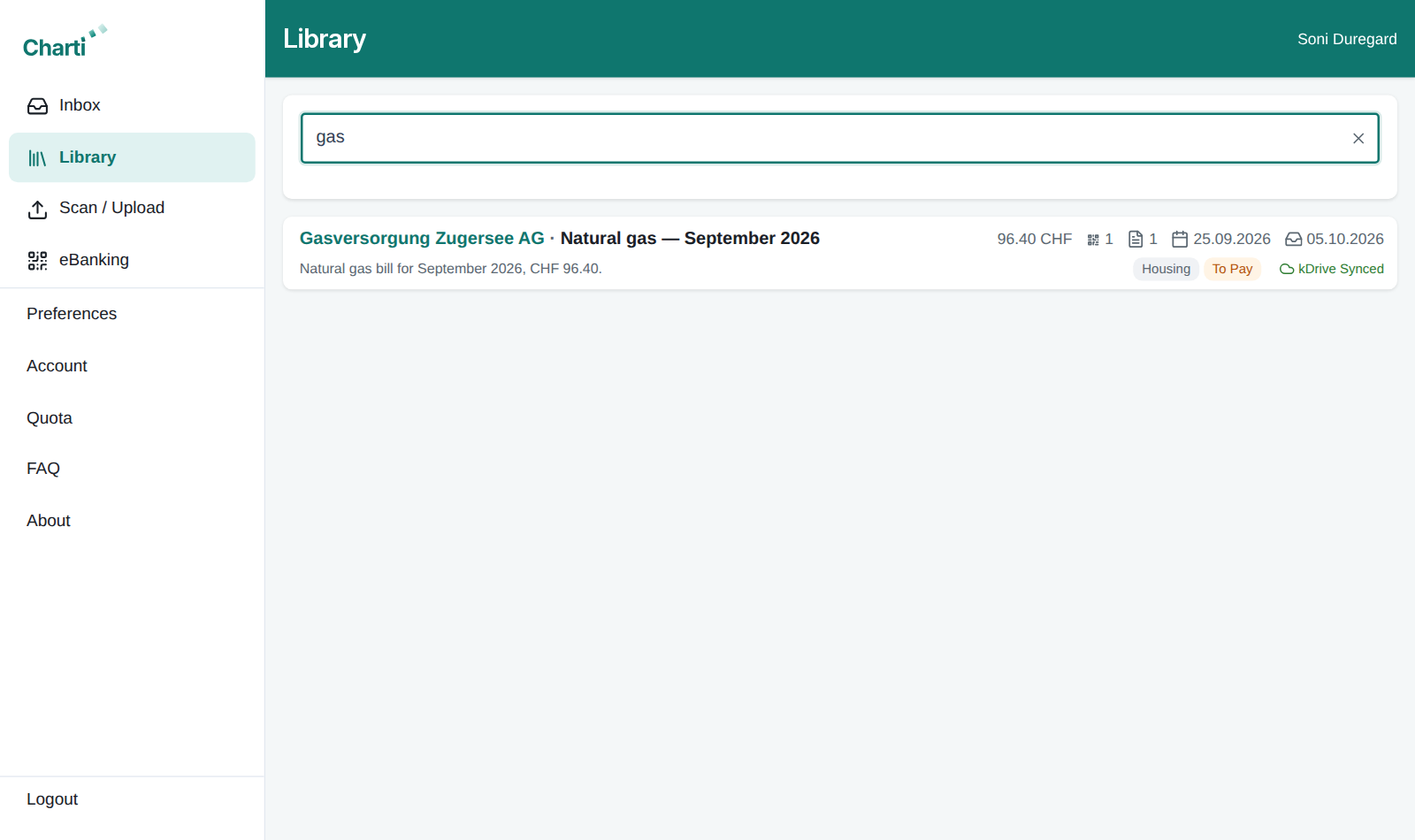
- Everything can be found in seconds. Search covers the full text of your documents: “dentist 2022” is enough to find the bill.
- A copy always stays with you. Every filed document is synced to your computer or your cloud. If the service closed tomorrow, you would lose nothing.
- Your documents stay in Switzerland. Data is hosted in Switzerland.
Frequently asked questions
How long should I keep my tax return?
10 years, with all the supporting documents for the deductions you claimed. The tax authorities can open a back-tax procedure up to 10 years after the end of the tax period (art. 152 Federal Direct Tax Act, DBG).
How long should I keep my health insurer’s statements?
5 years, because claims for medical treatment expire after 5 years (art. 128 no. 3 Code of Obligations, CO). If you deducted your medical expenses in your tax return, keep them for 10 years.
When does the clock start?
For a bill, when it falls due, in practice on its due date (art. 130 CO). For a company’s accounting records, at the end of the financial year (art. 958f CO). For tax, at the end of the tax period.
Is a bank statement enough as proof of payment?
Usually yes: it shows the date, the amount, the payee and, for a QR bill, the payment reference. The safest approach is still to keep the bill and the proof of payment together, so you can show what was paid and not just that an amount left your account.
Do I need to keep bills received through eBill?
Yes, for the same periods as paper bills. Your bank’s eBill portal is not designed as an archive: if you change bank, the history does not follow you. Download the PDF and file it with your other documents.
How should I get rid of old documents?
Your papers contain your AHV number, your IBAN and health information: shred them rather than putting them in the paper recycling. The best time for a clear-out is just after you have filed your tax return, once a year.
This guide is for information only and is not legal or tax advice. If in doubt, ask your cantonal tax office or your fiduciary.