Preparing your documents for your accountant: the complete list
In short. A fiduciary (an accountant) bills their time: every missing document, every record to track down, every back-and-forth by e-mail is paid for. Hand over one single folder, complete, organised, in one go, as soon as the year-end statements have arrived. Below are the two lists: a private individual’s tax return, and a self-employed person’s year-end closing.
List 1: a private individual’s tax return
Forms and deductions vary from one canton to another: your fiduciary will tell you what is missing. This list covers most situations; the deadlines and documents for the main cantons are in Swiss tax return: deadlines and documents.
Income
- Salary certificate(s) from each employer
- Pension statements: AHV, IV (disability insurance), occupational pension
- Benefits: unemployment, sickness, accident, loss-of-earnings allowances
- Side income, rental income, maintenance payments received
Assets and debts
- Year-end tax statements for each bank and postal account (balance and interest at 31 December)
- Tax statement for the securities account
- Surrender value of life insurance
- Interest statements: mortgage, loans, leasing
Deductions
- Certificate of payment into pillar 3a
- Certificate of occupational pension buy-in
- Unreimbursed medical and dental costs, with the health insurer statements
- Statement of health insurance premiums, and of any subsidies received
- Childcare costs
- Continuing education costs
- Donations to charitable organisations
- Maintenance payments made
- Professional expenses not covered by a flat rate (depending on your canton)
- Homeowners: property maintenance invoices
Situation
- Last return and last tax assessment
- Any change during the year: marriage, birth, separation, move, new job, purchase or sale of a property
How long should you keep all this afterwards? See How long to keep your bills and documents in Switzerland
List 2: a self-employed person’s year-end closing
Bank and cash
- Statements for all business accounts for the year, with the balance at 31 December
- Cash book, if you take payment in cash
- Statements for business credit cards
Sales
- All invoices issued during the year
- The list of open customer invoices at 31 December (debtors)
Purchases and expenses
- All supplier invoices for the year, with proof of payment
- The list of open supplier invoices at 31 December (creditors)
- Expense receipts (business meals, travel, small equipment)
- Invoices for equipment purchases (machinery, IT, vehicle)
Contracts and commitments
- New contracts of the year: commercial lease, leasing, loans, insurance
- Self-employed AHV/IV/EO contribution statements
- VAT returns, if you are VAT-registered
- Salaries: statements and certificates, if you have employees
Year end
- Inventory of stock and work in progress at 31 December
- Private share: private use of the vehicle, home office, benefits in kind
All these records are then kept for 10 years: see Retention of accounting records in Switzerland.
How to deliver the folder
One folder per year, subfolders by category, following the headings above. And in each subfolder, files that read by themselves:
2026-03-15 Dupont Printers - Invoice 4512.pdf
The rules that save your fiduciary time, and therefore save you money:
- PDFs, not blurry photos. One document per file, all its pages.
- In one go. A complete folder, rather than twenty e-mails over several weeks.
- A list of what is missing. If a certificate has not arrived yet, say so, rather than leaving your fiduciary to chase it.
- A share, not attachments. A folder shared from a trusted cloud, or your fiduciary’s portal, is safer than dozens of e-mails.
- Private apart from business. Two folders, even if a single fiduciary handles both.
To set up filing all year round, and not only in January: How to organise your administrative documents.
A folder ready for your fiduciary, all year
The year-end folder prepares itself if each document is filed the moment it arrives. That is what Charti does:
- Everything arrives in the same place: bills by e-mail to your @charti.ch address, paper post uploaded once scanned, portal documents through connectors.
- Each document is read and filed: type (salary certificate, statement, invoice…), issuer, recipient, date. Your own rules can add a tag, for example “send to fiduciary”.
- A copy arrives in your cloud, then on your computer. Choose filing by year: each year forms a folder, and in January all that is left is to share it.
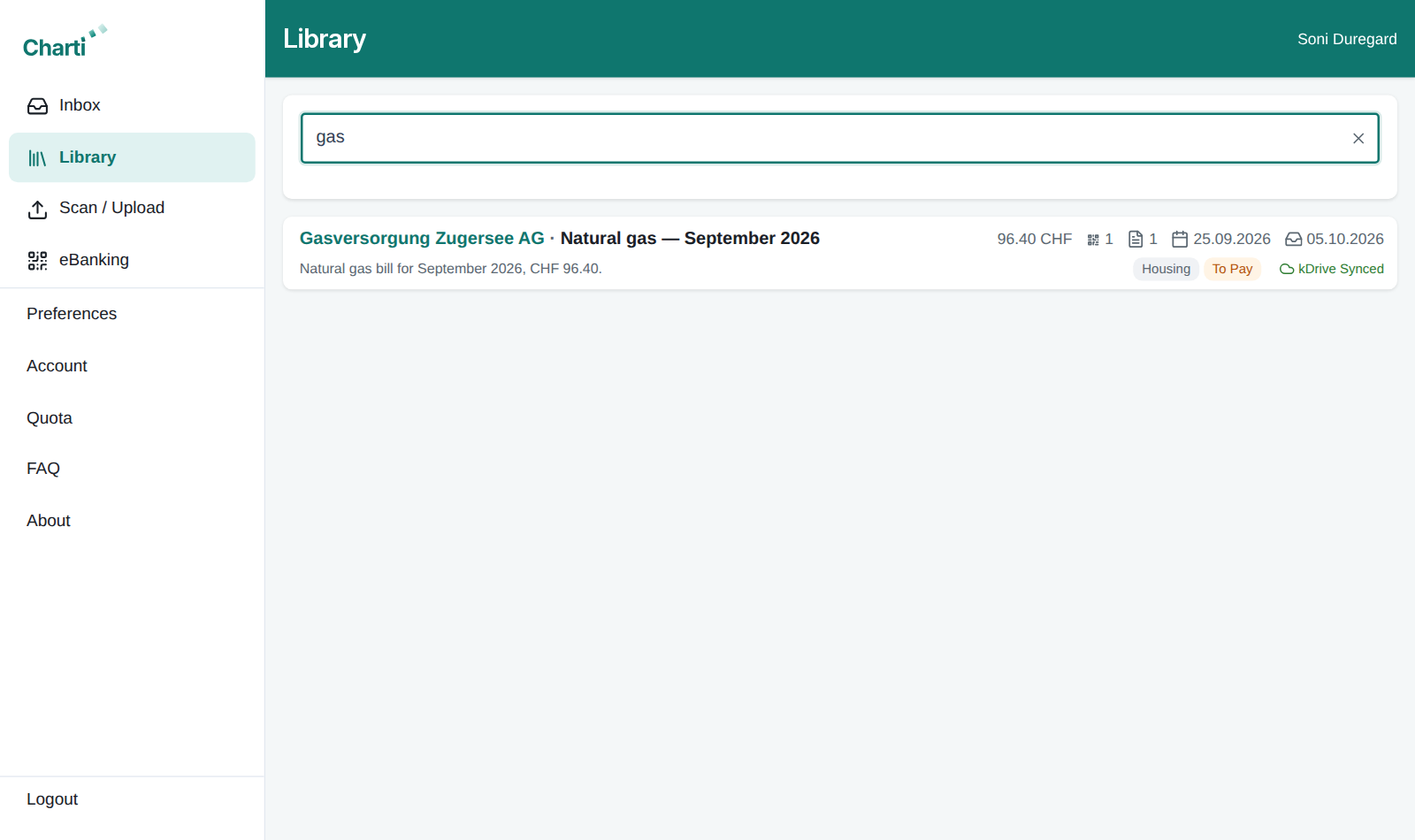
- Search covers the content: “3a certificate 2026” finds the document in a few seconds.
Frequently asked questions
Which documents should I give my fiduciary for the tax return?
At a minimum: your salary certificates or pension statements, the tax statements of your accounts and securities at 31 December, your pillar 3a and occupational pension buy-in certificates, the proof for your deductions (medical expenses, childcare costs, donations, debt interest), and your latest tax assessment. Your canton and your situation may ask for others.
Do I need to send the originals to my fiduciary?
Generally not: readable PDFs are enough, and you keep the originals. Ask your fiduciary what they prefer, especially for documents whose value lies in a signature.
How do I send documents to my fiduciary securely?
Avoid dozens of e-mail attachments: share a folder instead, from a trusted cloud, preferably hosted in Switzerland, or use your fiduciary’s portal. Remove access once the work is done.
When should I send my documents to my fiduciary?
As soon as the year-end statements have arrived, usually between January and February, and in any case before the date your fiduciary gave you. A complete file sent early costs less than an incomplete one sent at the last minute.
This guide is for information only and is not legal or tax advice. If in doubt, ask your cantonal tax office or your fiduciary.