Medical bills: how to get reimbursed by your health insurer
In short. In Switzerland, the basic rule is tiers garant: you receive the doctor’s bill, you pay it, and you send it to your health insurer to be reimbursed (art. 42 para. 1 KVG/LAMal). The insurer deducts the deductible and the 10% co-payment. You have 5 years to claim your rights (art. 24 ATSG/LPGA), but the simplest thing is to send each bill as soon as it arrives, through your insurer’s app, and to keep the bill and the statement together.
A bill from the paediatrician, another from the physiotherapist, a statement from the pharmacy, another from the insurer: in a household, health papers pile up fast. And a bill forgotten in a drawer is money that does not come back.
Tiers garant or tiers payant: who pays whom?
| Tiers garant | Tiers payant | |
|---|---|---|
| Who receives the bill | You | Your health insurer |
| Who pays the provider | You | Your insurer |
| What you do | Pay, then send the bill to the insurer | Check the copy you receive, then pay your share when the insurer bills you |
| Where you meet it | Most often at the doctor’s and the physiotherapist’s | Often at the pharmacy and the hospital |
Tiers garant is the rule, unless insurers and providers agree otherwise (art. 42 para. 1 KVG/LAMal). Tiers payant is agreed between them (art. 42 para. 2 KVG/LAMal); for hospital treatment, the insurer always pays its share directly.
Under tiers payant too, you receive the bill: the provider must send you a copy without you having to ask (art. 42 para. 3 KVG/LAMal). Read it: it is the only way to spot a service billed that you did not receive.
Sending a bill to your insurer: the method
- Check the bill: your name, the treatment dates, the services. A bill must be itemised and understandable (art. 42 para. 3 KVG/LAMal).
- Send it without a form: no form is required to claim benefits (art. 42 para. 6 KVG/LAMal). The quickest way is your insurer’s app: a photo or the PDF is enough. Otherwise, the customer portal, or the post.
- Pay the provider within the bill’s deadline, without waiting for the reimbursement: under tiers garant, you are the debtor.
- Check the statement from the insurer when it arrives: amount covered, deductible, co-payment.
- File the bill and the statement together, in the same place: it is what you will need for your tax return and if questions arise.
Supplementary insurance follows its own general terms. If your supplementary cover is with the same insurer, the bill you send often serves for both; otherwise, send it to the other insurer too.
What the insurer reimburses, and what it leaves to you
For basic insurance, you share in the costs (art. 64 KVG/LAMal):
| Cost-sharing | Adult | Child |
|---|---|---|
| Ordinary deductible | CHF 300 per calendar year | None |
| Optional deductibles | CHF 500, 1,000, 1,500, 2,000 or 2,500 | CHF 100 to 600 |
| Co-payment | 10% of costs above the deductible, at most CHF 700 a year | 10%, at most CHF 350 a year |
Sources: art. 64 KVG/LAMal, arts. 93 and 103 KVV/OAMal. It is the date of treatment that counts for the deductible and the co-payment (art. 103 para. 3 KVV/OAMal). No cost-sharing is charged on maternity benefits from the 13th week of pregnancy, during childbirth and up to eight weeks afterwards (art. 64 para. 7 KVG/LAMal).
Send bills below your deductible anyway. The insurer will reimburse nothing, but it will count them towards your deductible: that is what triggers the later reimbursements in the year.
How long do I have to send a bill?
The right to benefits lapses five years after the end of the month for which the benefit was due (art. 24 para. 1 ATSG/LPGA). In practice, do not wait: a bill sent straight away is reimbursed before the next one falls due.
Electronic bills: what is changing
Since 1 July 2026, the law provides that the provider issues their bill electronically, and on paper free of charge if you ask for it (art. 42 para. 3ter KVG/LAMal). The transmission standard still has to be agreed between providers and insurers: for a while, paper, PDF and bills sent directly to the insurer will coexist. One more reason to gather everything in the same place.
And for tax?
The medical costs you pay yourself, deductible and co-payment included, can be deducted above a threshold: for direct federal tax, the part that exceeds 5% of taxable income, reduced by the other deductions (art. 33 para. 1 let. h DBG). Cantonal thresholds vary. So keep bills and statements 10 years if you deduct them, 5 years otherwise: see How long to keep your bills and documents in Switzerland
Never forget a medical bill again
With Charti, medical bills join everything else:
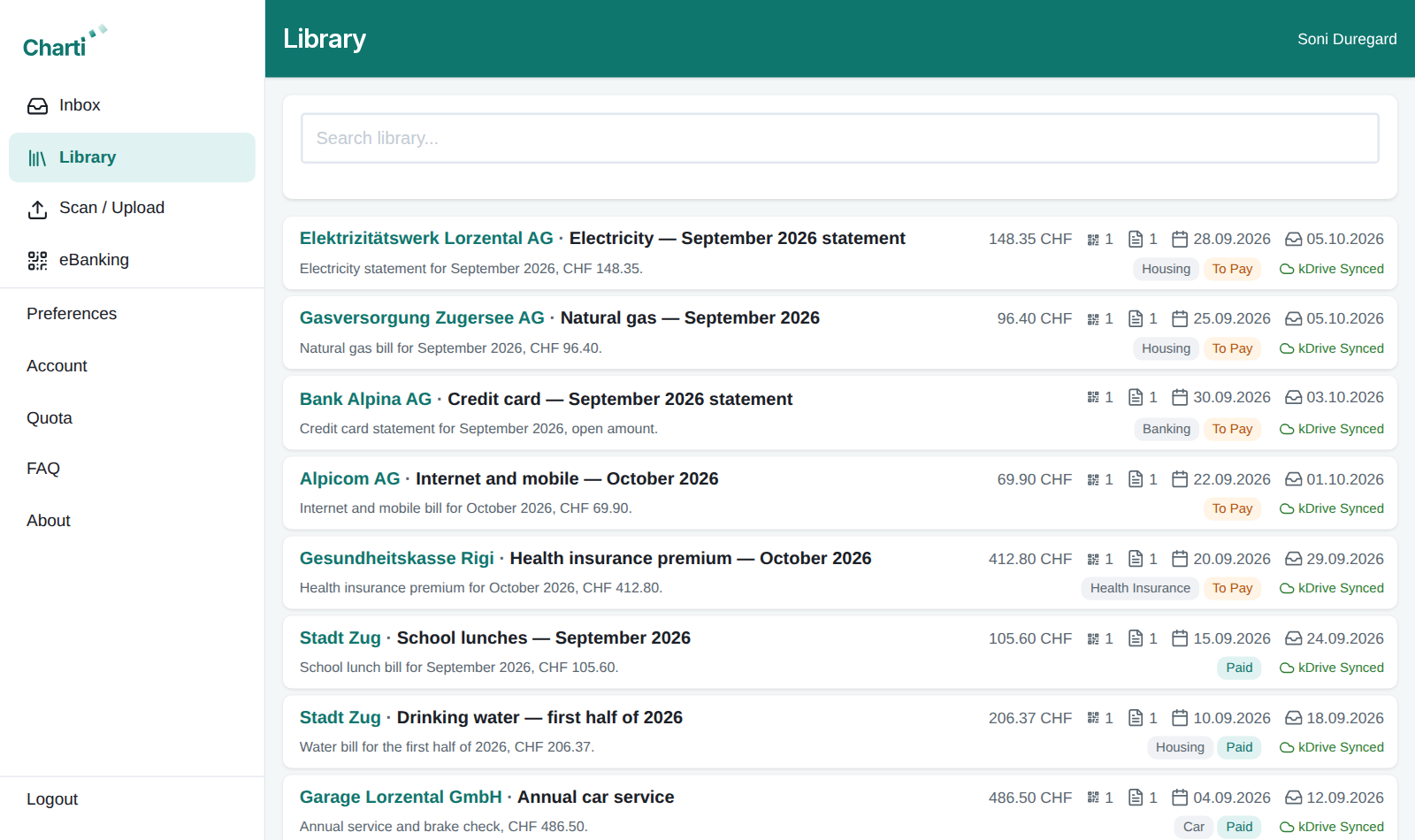
- Everything arrives in the same place: bills by e-mail to your @charti.ch address, paper bills uploaded once scanned, and, for some insurers, statements fetched from their portal by connectors.
- Each document is read and filed: medical bill, benefits statement, with the recipient (you, your partner, your children).
- A “to send to health insurer” tag: create a rule that adds it to your doctors’ bills, and you see at a glance what is left to send.
- Bills with a QR code are also tagged “To Pay”, so you pay the doctor on time.
- In February, search finds all the year’s medical bills for your tax return.
Frequently asked questions
How long do I have to send a bill to my health insurer?
The right to benefits lapses five years after the end of the month for which the benefit was due (art. 24 General Part of Social Insurance Law, ATSG/LPGA). But do not wait: send each bill as soon as it arrives, so you are reimbursed before you have to pay the next one.
Do I have to pay the doctor before being reimbursed?
Under the tiers garant system, yes: you owe the bill to the doctor, and your insurer then reimburses you (art. 42 para. 1 Health Insurance Act, KVG/LAMal). Pay within the time shown on the bill, even if the reimbursement has not yet arrived.
Why does my insurer not reimburse everything?
Because of cost-sharing: the deductible (franchise; at least CHF 300 a year for an adult, more if you chose a higher optional deductible), then a 10% co-payment (quote-part) on costs above it, up to CHF 700 a year for an adult (art. 64 KVG/LAMal, art. 103 KVV/OAMal).
What is tiers payant?
A system in which the insurer pays the provider directly, often the pharmacy or the hospital. You pay only your share, which the insurer then bills you. The provider must send you a copy of the bill without you having to ask (art. 42 para. 3 KVG/LAMal).
Do I need a form to claim a reimbursement?
No: no form is required to claim benefits under basic insurance (art. 42 para. 6 KVG/LAMal). The bill is enough, sent through the app, the customer portal or by post.
This guide is for information only and is not legal or tax advice. If in doubt, ask your cantonal tax office or your fiduciary.