Swiss tax return: deadlines and documents in Zurich, Geneva, Vaud, Basel and Zug
In short. Deadlines for the latest campaign: 15 March in Vaud, 31 March in Zurich, Geneva and Basel-Stadt, 30 April in Zug. An extension is easy to get, as long as you ask before the deadline. The slow part is not filling in the return: it is finding the documents. Start there, as soon as the year-end statements have arrived.
If you have just arrived in Switzerland, expect to fill in a tax return every year and file it yourself, in the canton where you live. This guide covers the five cantons where most English speakers live: Zurich (ZH), Geneva (GE), Vaud (VD), Basel-Stadt (BS) and Zug (ZG). Other cantons work in much the same way, with their own dates.
Deadlines and extensions, canton by canton
The rules below are those of the latest campaign we could check (the 2025 return, filed in 2026), except for Geneva, where the latest dates we could confirm are those of the 2024 return. They change little from one year to the next, but the date that counts is the one on your return and on your canton’s website.
| Canton | Ordinary deadline | Extension | Online tool |
|---|---|---|---|
| Zurich | 31 March | Request to your municipal tax office (Gemeindesteueramt) before the deadline; some municipalities let you do it online. Requests made in time are granted until 30 November at the latest. No fee is mentioned in the cantonal instructions | ZHprivateTax (login with AGOV) |
| Geneva | 31 March (2024 return) | Online request (e-démarches) before the deadline; paid | GeTax |
| Vaud | 15 March | Tolerance to 30 June without a request; to 30 September on an online request, free of charge | VaudTax (online service) |
| Basel-Stadt | 31 March | Free to 30 September, online via the tax portal; further requests CHF 40 | BalTax Online (esteuern.bs.ch) |
| Zug | 30 April | Request before the deadline through the canton’s online form; the cantonal page mentions no fee | eTax.zug (login with AGOV) |
What to remember:
- Ask for the extension before the deadline, not after: an expired deadline cannot normally be extended. In Zurich, late requests are refused.
- Being late costs money: a reminder, sometimes with a fee (CHF 40 in Basel-Stadt), then an administrative fine, and as a last resort an assessment at the tax authority’s discretion, on an estimate (art. 130 para. 2 Federal Direct Tax Act, DBG). An estimate is rarely in your favour. In Basel-Stadt, ignoring a reminder can lead to a fine of up to CHF 1,000, and up to CHF 10,000 in serious cases.
- Self-employed people generally get longer deadlines, especially when a fiduciary (an accountant) fills in the return. In Zurich, for example, the municipal tax offices extend the deadline to 30 September by themselves for resident self-employed people.
- File online if you can. Zurich, Basel-Stadt and Zug now push the online channel: you upload your supporting documents as PDFs or photos, and in Zurich and Basel-Stadt you need no signature or printout.
The documents to gather
The year-end statements arrive between January and February. Gather them as they come, in a single “Tax 2026” folder:
Income
- Salary certificate(s) (Lohnausweis, certificat de salaire)
- Pension statements: AHV/AVS, IV (disability insurance), pension fund
- Benefits: unemployment, sickness, accident, loss-of-earnings allowances
Assets and debts
- Tax statements for each account at 31 December
- Tax statement for the securities account
- Mortgage or loan interest statements
Deductions
- Certificate of payment into pillar 3a
- Certificate of occupational pension buy-in
- Unreimbursed medical costs, with the health insurer statements (see Medical bills: how to get reimbursed by your health insurer)
- Health insurance premiums and any subsidies received
- Childcare costs, continuing education, donations
- Homeowners: property maintenance invoices
To get your bearings
- The previous year’s return and tax assessment: they show what you declared and what the authority accepted.
For a fuller list, and for the self-employed, see Preparing your documents for your accountant.
A simple calendar
| When | What |
|---|---|
| All year | File each document as it arrives |
| January | Request the statements that do not arrive by themselves |
| February | Gather everything in the year’s folder; check nothing is missing |
| Before the deadline | Fill in the return, or request an extension |
| After sending | File the return and the assessment; sort out papers that have passed their retention period |
How long should you keep all this? 10 years, since the authorities can open a back-tax procedure for 10 years: see How long to keep your bills and documents in Switzerland
Your tax folder, ready in February
With Charti, the folder builds up all year:
- Each document is recognised and filed as soon as it arrives: salary certificate, tax statement, pillar 3a certificate, medical bill, health insurer statement, with the issuer and the recipient. Summaries are written in the language you choose, so a German-language salary certificate can be summarised in English.
- A rule can add a “Taxes” tag to the documents that feed the return, for example everything that comes from your bank or your pension fund.
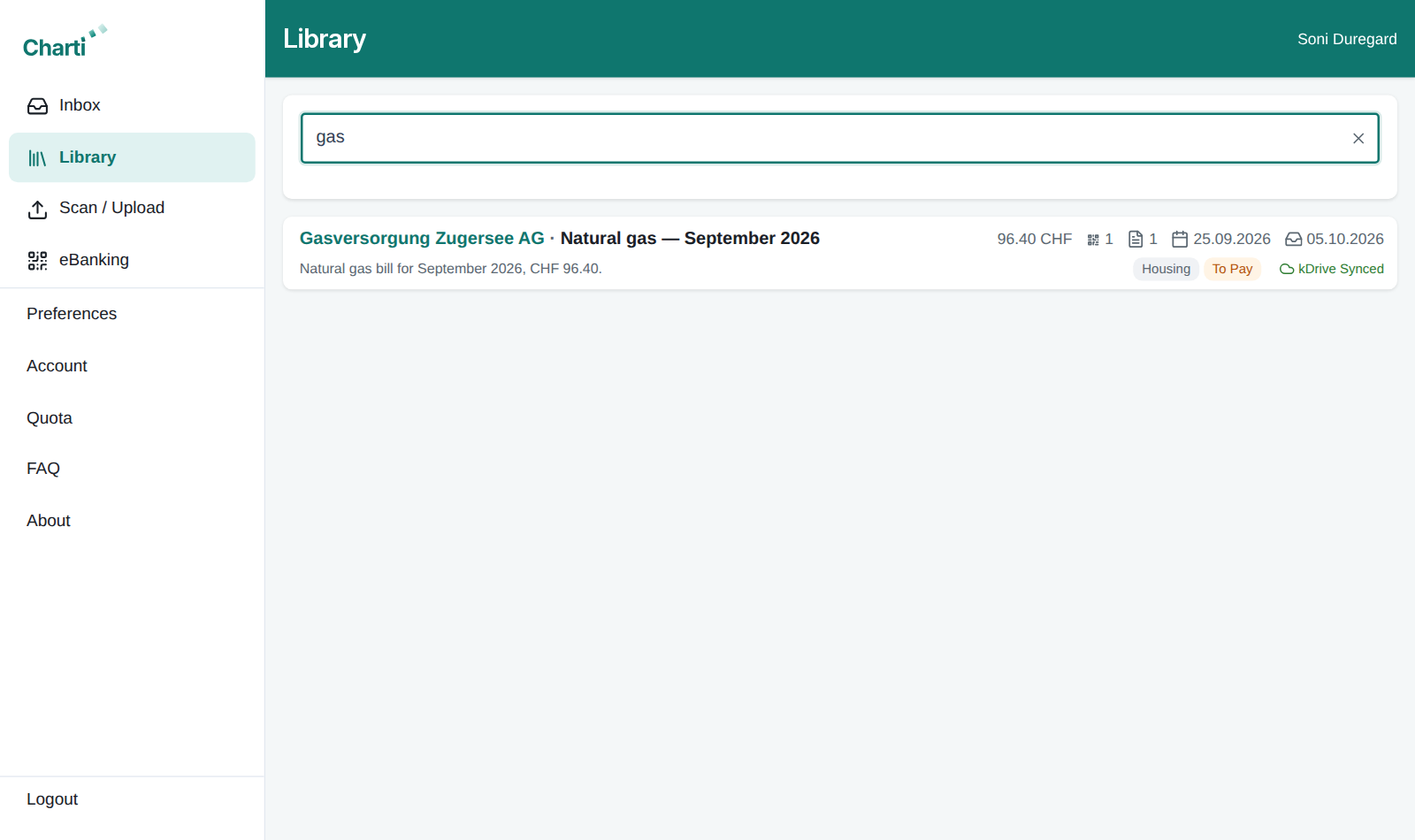
- Search covers the content: “3a certificate 2026” or “salary certificate” finds the document in a few seconds.
- A copy arrives on your computer, ready to be uploaded to your canton’s tool or handed to your fiduciary.
Frequently asked questions
When do I have to file my tax return in Zurich, Geneva, Vaud, Basel-Stadt and Zug?
For the latest campaign: 31 March in Zurich, Geneva and Basel-Stadt, 15 March in Vaud (with a tolerance period to 30 June) and 30 April in Zug. The exact dates are repeated every year on the return and on your canton’s website.
How do I get an extension?
By asking before the deadline expires, mostly online. In Zurich the request goes to your municipal tax office and can be made online in some municipalities; in Basel-Stadt a first extension to 30 September is free; in Vaud a tolerance period to 30 June applies without a request; in Geneva the online request is paid; in Zug it is requested through the canton’s online form.
What happens if I file my return late?
You receive a reminder or a summons, sometimes with a fee (CHF 40 in Basel-Stadt), then a fine. If you still do not file, the tax authority assesses you at its discretion, on an estimate (art. 130 para. 2 Federal Direct Tax Act, DBG).
Which documents do I need to fill in my tax return?
Your salary certificates, the tax statements of your accounts at 31 December, your pillar 3a and occupational pension buy-in certificates, the proof for your deductions (medical expenses, childcare costs, donations, debt interest) and your latest tax assessment.
Do I have to attach the supporting documents to my return?
It depends on the canton and the document: some documents must be attached, others kept and produced on request. The cantons’ online tools say what to upload. In every case, keep them for 10 years.
This guide is for information only and is not legal or tax advice. If in doubt, ask your cantonal tax office or your fiduciary.