Paper bill fees in Switzerland: how to stop paying them
In short. Several suppliers charge for sending a paper bill: at Swisscom it is CHF 2.90 per bill, according to its price list. With three suppliers charging every month, you get close to CHF 100 a year. To stop paying, switch to an electronic bill: eBill or a PDF by e-mail. The only risk is letting a bill get lost in your mailbox: the answer is to have them all arrive in the same place.
Who charges for the paper bill?
For some years now, more and more companies have charged for printing and sending their bills, especially in telecoms. Swisscom has done so since October 2019: CHF 2.90 per paper bill, according to its price list. Other suppliers have similar fees, others none.
The amount and its exceptions are in the supplier’s price list or general terms. Look for “paper bill”, “postage fee” or “processing fee” on your latest bill: they often appear on a separate line.
The sums are worth working out:
| Paying paper bills | Per month | Per year (at CHF 2.90) |
|---|---|---|
| 1 supplier | 1 | CHF 34.80 |
| 3 suppliers | 3 | CHF 104.40 |
| 5 suppliers | 5 | CHF 174 |
Medical bills are an exception: for basic health insurance, the law provides that the provider issues their bill electronically, and on paper free of charge if you ask for it (art. 42 para. 3ter Health Insurance Act, KVG/LAMal).
The 3 ways to receive your bills without paper
1. eBill. The bill arrives straight in your e-banking and is paid with a click. It is the simplest solution for suppliers that offer it. The only limit: the PDF stays in the eBill portal only for at least 730 days after the due date. Our comparison: eBill or QR bill.
2. A PDF by e-mail. The bill, with its payment part and its QR code, arrives by e-mail. You pay it by scanning the QR code from the screen with your banking app (see How to pay a Swiss QR bill).
3. The customer portal. Some suppliers put the bill in your customer area and only send you a notice. It is the least convenient: you have to go and fetch it, every month.
How to switch, supplier by supplier
- List your paper bills from the last month. Those are the ones to change.
- Log in to each supplier’s customer area, under billing or delivery method, and choose the electronic bill. Otherwise, a call to customer service is enough.
- Activate eBill in your e-banking for those that offer it, or give a billing e-mail address for the others.
- Check the next bill: it should arrive through the new channel, with no paper fee.
The real risk: the bill lost in your e-mails
The paper bill had one advantage: it stayed on the table until you paid it. A bill by e-mail drowns between two newsletters, and a reminder arrives with its fees, higher than the paper ones.
The remedy: have all electronic bills arrive in the same place, and see at a glance what is left to pay.
A billing address that loses nothing
With Charti, give your personal @charti.ch address as your billing e-mail address to your suppliers, or forward their e-mails to it (see collection):
- Each bill is read and filed, with the issuer and a short summary.
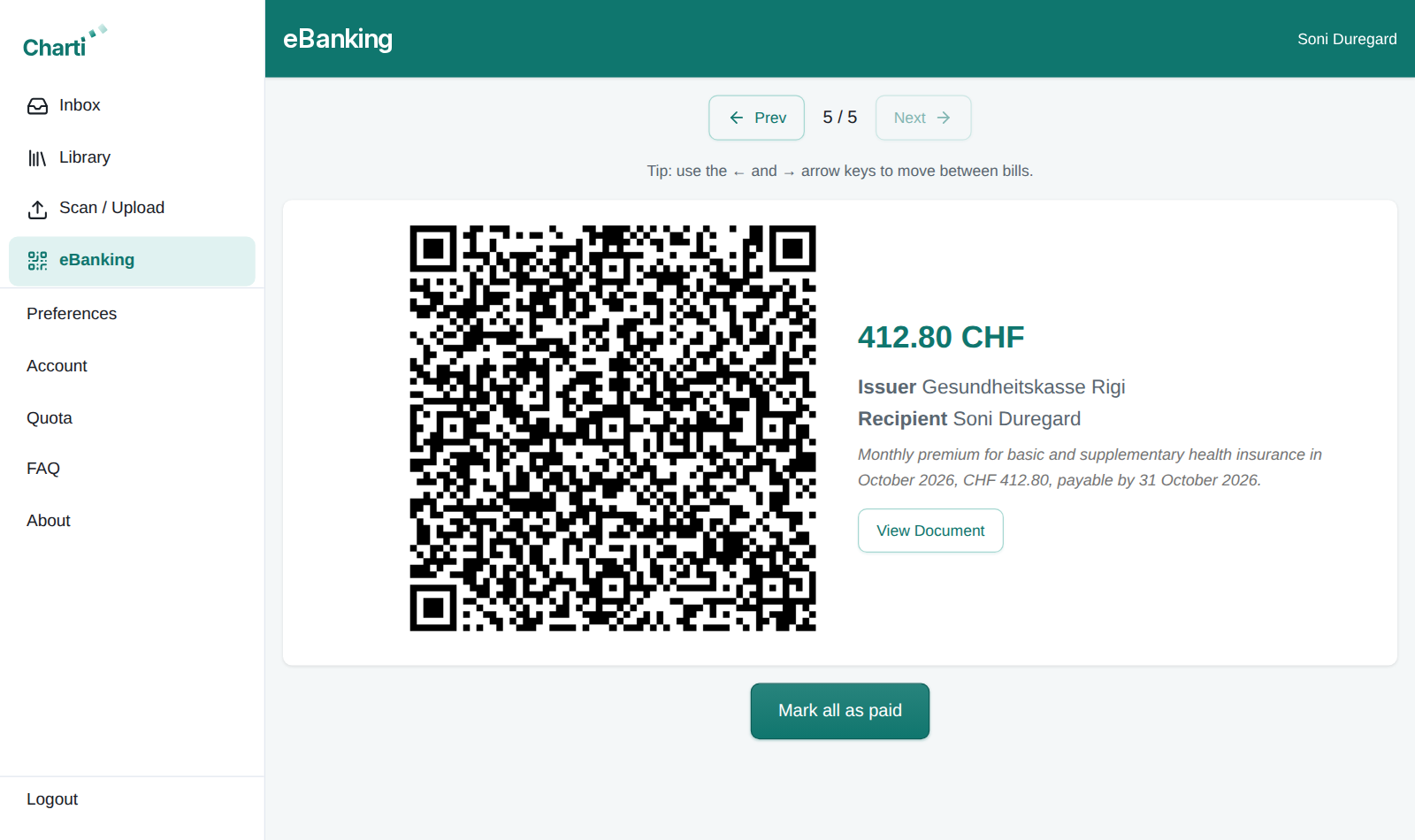
- QR bills are tagged “To Pay” and gathered in the eBanking view, to pay them all in a row.
- Reminders get their own tag, so they do not go unnoticed.
- A copy of every bill arrives on your computer: your archive depends neither on your mailbox nor on the supplier’s portal.
Frequently asked questions
How much does a paper bill cost?
It depends on the supplier: at Swisscom, a paper bill costs CHF 2.90, according to its price list. Other suppliers charge a similar amount, others nothing at all. The amount is in your supplier’s price list or general terms.
How can I avoid paper bill fees?
Switch to an electronic bill: eBill in your e-banking, or a PDF by e-mail. The change can usually be made in the supplier’s online customer area, in a few clicks.
Can medical bills carry paper fees?
No. For basic health insurance, the provider issues their bill electronically, and on paper free of charge if you ask for it (art. 42 para. 3ter Health Insurance Act, KVG/LAMal).
What if I do not want an electronic bill?
Ask your supplier whether they allow exceptions. At Swisscom, for example, customers who have only universal-service products do not pay for the paper bill. Otherwise, compare: another supplier may not charge these fees.
This guide is for information only and is not legal or tax advice. If in doubt, ask your cantonal tax office or your fiduciary.