Supplier invoices: the simple method for the self-employed
In short. A 5-step method is enough to stop losing supplier invoices:
- Receive all invoices in one place, separate from your private ones.
- Check each invoice before paying it.
- Pay on the due date, in one or two sessions a month.
- Pass the records to your accounting or your fiduciary (accountant) as you go.
- Archive for 10 years from the end of the financial year (art. 958f CO).
When you are self-employed, supplier invoices arrive from everywhere: a PDF from the materials supplier, a software subscription charged to your card, the printer’s paper invoice, the rent of the workshop. And they get mixed up with private bills in the same mailbox. Here is a method that lasts.
1. Receive: one place, separate from private
- A billing e-mail address to give to all your suppliers. Every invoice arrives there, and nothing else.
- A business bank account: paying business invoices from this account, and only those, makes the accounts readable at a glance.
- Supplier portals (telecoms, software, energy): ask for invoices to be sent by e-mail, or download them each month to the same place.
- Paper: a “business invoices” tray, scanned every week.
2. Check before paying
Three checks, thirty seconds per invoice:
- The service: was it ordered and delivered? Does the amount match the quote or the order?
- The form, if you are VAT-registered: to claim back input tax, the invoice must as a rule show the supplier’s name and place with their VAT number, your name and place, the date or period of the service, its nature, the amount, and the VAT rate and amount (art. 26 para. 2 VAT Act).
- The payee: the name your bank shows when you pay must be the supplier’s. Fake invoices target the self-employed too.
3. Pay on the due date, not on receipt
Paying too early ties up your cash. Paying too late costs you: if a payment date was agreed, you are in default as soon as it has passed, even without receiving a reminder (art. 102 para. 2 CO), and the supplier can demand default interest of 5% a year (art. 104 CO).
Good practice: one or two payment sessions a month, on a fixed date. You scan all the QR bills one after the other, choosing each bill’s due date as the execution date, then approve everything at once. The detailed method: Paying several QR bills at once.
If your supplier offers a discount for quick payment (for example 2% at 10 days), pay that invoice within the discount period: it is often the best return on your cash.
4. Pass records to accounting as you go
Do not keep everything for the end of the year. Depending on your set-up:
- You keep your own accounts in software (bexio, Banana…): enter each supplier invoice when you pay it.
- Your fiduciary keeps your accounts: put the records in a folder for the year, by month or by supplier, and share it with them every quarter. Note the payment date on the invoice, or in its file name.
What your fiduciary will ask for at year end is detailed in Preparing your documents for your accountant.
5. Archive for 10 years
Supplier invoices are accounting records: they are kept for 10 years from the end of the financial year (art. 958f para. 1 CO). For a self-employed person, tax law repeats it, even with simplified accounting (art. 126 para. 3 DBG). Electronic storage is accepted, under certain conditions: see Retention of accounting records in Switzerland.
Supplier invoices with Charti
Charti takes care of steps 1, 3 and 5, the ones that take the most time for the least value:
- Receive: give your @charti.ch address to your suppliers as the billing address. An unknown sender is held until you approve it, once: a stranger cannot slip a fake invoice in among yours.
- Tell apart: Charti recognises the issuer and the recipient of each document, you or your company, and remembers your corrections for the next invoices from the same supplier.
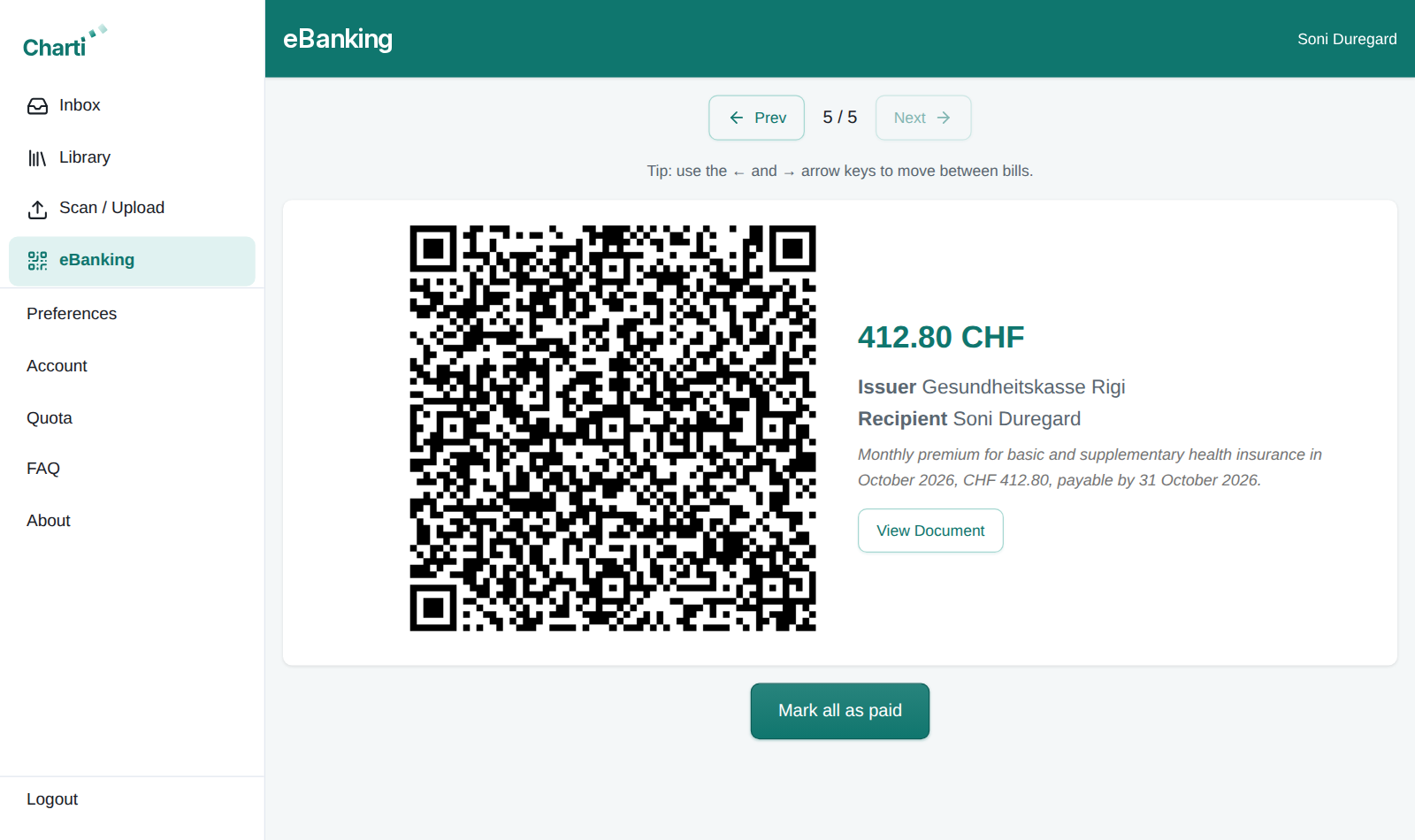
- Pay: each QR bill is tagged “To Pay” and joins the eBanking view; reminders get their own tag. One payment session, then everything is marked as paid in a single gesture.
- Archive: each validated record arrives in your cloud, filed the way you choose: by issuer then by year, by year first, or in your own folder structure. Filed by year, your records form one folder per financial year, to share with your fiduciary from your cloud.
- With several people: add a partner or a colleague to the account, each with their own access.
Frequently asked questions
What happens if I pay a supplier invoice late?
If a payment date was agreed, you are in default as soon as it has passed, even without receiving a reminder (art. 102 para. 2 Code of Obligations, CO). The supplier can then demand default interest of 5% a year (art. 104 CO), on top of any reminder fees provided for.
What must an invoice contain for me to claim back VAT?
As a rule: the supplier’s name and place with their VAT number, your name and place, the date or period of the service, its nature, the amount, and the VAT rate and amount (art. 26 para. 2 VAT Act). If something is missing, ask for a corrected invoice before paying.
How do I separate private and business invoices?
A separate business bank account, a dedicated billing e-mail address, and separate folders. Pay business invoices from the business account: it is what makes the accounts readable for your fiduciary (accountant).
How long should I keep supplier invoices?
10 years from the end of the financial year (art. 958f CO). The self-employed are subject to this for tax as well (art. 126 para. 3 Federal Direct Tax Act, DBG), even with simplified accounting.
Do I need accounting software to manage supplier invoices?
No. If your fiduciary keeps your accounts, what you mainly need is a single place where all invoices arrive, a payment routine, and well-organised records to hand over. Accounting software becomes useful if you keep your accounts yourself.
This guide is for information only and is not legal or tax advice. If in doubt, ask your cantonal tax office or your fiduciary.